Introduction
Minda required more than a basic monitoring layer for its lock assembly operations. The business needed a digital manufacturing system that could standardize execution, improve line discipline, strengthen traceability, and give plant teams a unified operational view across multiple assembly lines and plants. In the supplied assembly line case study, FactoryMetrics is described as a smart Industry 4.0 system that provides a 360-degree view of shopfloor activity and acts as the operational control layer for the manufacturing process.
The deployed model was especially relevant for assembly operations where production continuity depends on synchronized control of operator readiness, material availability, line verification, downtime response, and reporting accuracy. According to the case study material, Spark Minda implemented FactoryMetrics across 30 assembly lines at the Noida SSD plant. Based on your note, the same solution approach also connected the Pune and Noida plants and has created the confidence to extend the system to other Minda facilities.
Challenges
Minda’s requirement was structurally similar to the Brembo use case because the objective was not simply to digitize one report or one line, but to create a connected system that could enforce process discipline while improving plant-wide visibility. The supplied feature sheet and assembly line case study point to a manufacturing environment that required standardized operator login, plan-based execution, BOM visibility, line interlocks, downtime accountability, escalation logic, digital documents, and dynamic reporting.
|
Challenge Area
|
Minda Requirement
|
|
Multi-line control
|
The SSD business needed a solution that could work consistently across a large assembly setup rather than only on isolated stations.
|
|
Multi-plant scalability
|
The model had to be strong enough to support deployment across Pune and Noida and then expand to other plants, as you indicated.
|
|
Operator discipline
|
Line execution depended on validating operator attendance and skill before production could begin.
|
|
Material readiness
|
The process required line-side confirmation of BOM and child-part availability before running production.
|
|
Process adherence
|
Checklist completion and line verification had to be enforced before the line could start.
|
|
Downtime response
|
Downtime needed structured categorization, automatic ticketing, notifications, and escalation to the right authority.
|
|
Reporting and accountability
|
Plant teams needed automated KPI visibility rather than delayed manual reporting.
|
Hiotron Solution
Hiotron implemented FactoryMetrics as a connected digital manufacturing platform for Minda’s SSD lock assembly operations. The solution architecture combined operator authentication, production planning, material verification, assembly-line interlocking, downtime ticketing, escalation logic, checklist digitization, and KPI reporting into one operational system.
A defining part of the solution was 4M-based control. The system verified the readiness of Man, Machine, Method, and Material before permitting production. Operators and line leaders could be validated through biometric login, while the system also supported skill-wise operator login at every station, automatic logout at shift end, and a rule that the line should not operate if the required operator login was missing.
On the planning and materials side, the feature sheet shows support for line-wise plan creation, plan loading, BOM display based on the loaded plan, and inventory filling through manual input or barcode scanners. If BOM inventory did not match the planned quantity, the system could apply a line interlock, ensuring that production could not continue under a materials deviation.
Method control was addressed through digital documents and checklists, including LVS and DRS workflows. The case study PDF further states that the assembly line could not be started until prerequisite checks were completed, including operator attendance and skill verification, availability of raw materials or child parts, and the filling and submission of the line verification checklist. This created a strong digital control point for SOP compliance.
Downtime handling was structured through ticket creation and categorization. The feature sheet describes 4M-based downtime booking, automatic ticket generation, notifications by email or SMS, response by the respective authority, and measurement of ticket open-to-close time. The PDF reinforces that when a production line went down for any 4M reason, the right personnel received an alert with escalation metrics, and the system automatically recorded timestamps, problems, and resolution remarks. This enabled the generation of MTTR and MTBF analytics while improving accountability and responsiveness on the shopfloor.
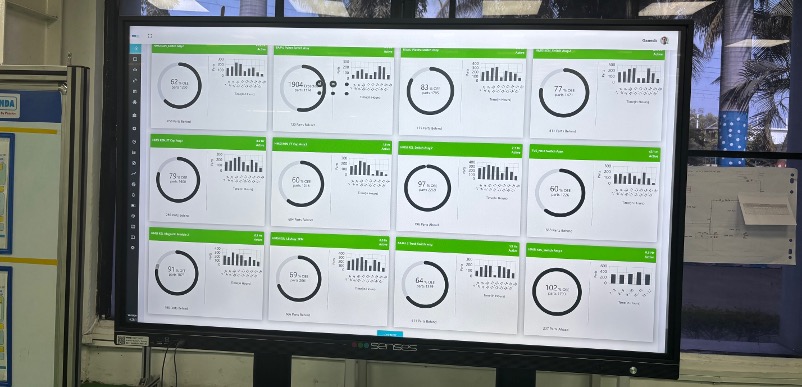
The output layer was equally strong. The supplied feature sheet shows dynamic reports, charts, and graphs for OEE, downtime, parts produced, utilization, operator attendance, cycle analysis, rejections, line timeline view, and Andon display, along with preventive maintenance and dynamic escalation rules. The PDF adds that the Noida SSD team used modules such as automatic downtime capture, manual downtime capture through tablets, digital checklists, machine interlocking, automatic rejections and rework, line and manpower utilization, production planning and scheduling, preventive maintenance, and reports including MTTR, MTBF, rejection, rework, quality, hourly, LVS, and DRS.
|
Solution Capability
|
What Hiotron Delivered
|
|
Operator control
|
Biometric and skill-based login, shift auto logout, and no-login interlocks.
|
|
Planning and execution
|
Line-wise plan creation and loading with BOM visibility tied to the production plan.
|
|
Material verification
|
Manual or barcode-based BOM inventory entry with shortage interlock logic.
|
|
Process discipline
|
Digital LVS and DRS workflows, checklist completion, and line-start interlocking.
|
|
Downtime management
|
4M categorization, ticket creation, email/SMS alerts, resolution tracking, and escalation.
|
|
Analytics
|
OEE, downtime, utilization, cycle analysis, attendance, rejection, and line timeline reporting.
|
|
Maintenance intelligence
|
Preventive maintenance plus MTTR and MTBF reporting for bottleneck improvement.
|
|
Plant scalability
|
A repeatable assembly-line model proven at Noida SSD and positioned for wider plant rollout.
|
Business Impact
In Brembo-style terms, the strength of the Minda project lies in how it converted assembly-line operations from fragmented manual supervision into a connected, rule-driven digital execution environment. The supplied case study shows that FactoryMetrics became a practical system for attendance validation, line interlocking, downtime accountability, material readiness, planning, utilization tracking, rejection reporting, and maintenance analytics across the Noida SSD operation.
This matters because the solution did not stop at visualization. It enforced production readiness before line start, escalated downtime to the right people, and created timestamped accountability around issues and resolutions. That kind of structure improves operational discipline and gives management a stronger basis for continuous improvement. Your note that Minda is now taking Hiotron to additional plants suggests that the project delivered not only technical success but also organizational confidence in the deployment model.