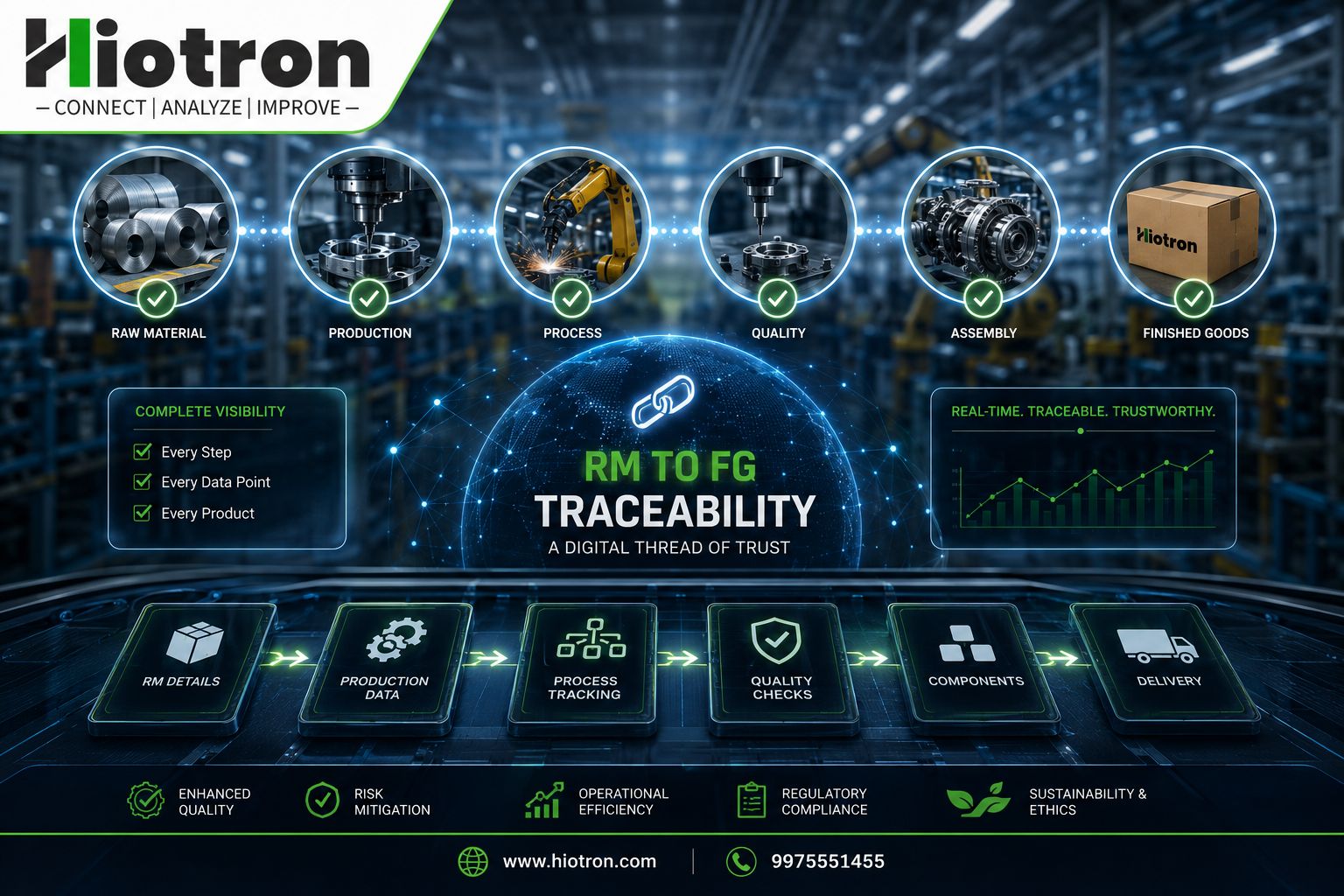
Ask any plant head what they produced last month and you will get an answer in seconds. Ask them which raw material batch went into the products shipped to their biggest OEM customer — and in most factories, someone starts pulling out registers, Excel sheets and dispatch files. In modern manufacturing, knowing what you produced is no longer enough. You need to know the complete story of how every single product came to be. That is exactly what RM to FG traceability — Raw Material to Finished Goods — delivers.
For Indian manufacturers supplying automotive OEMs, aerospace customers, medical device brands and export markets, this is no longer a nice-to-have. Customer audits demand it, standards like IATF 16949 expect it, and a single recall without traceability can cost more than the entire system that would have prevented it.
What Is RM to FG Traceability?
RM to FG traceability is the ability to reconstruct the complete manufacturing journey of any product — forwards or backwards — across the chain: Raw Material → Production → Process → Quality → Assembly → Finished Goods. A complete digital thread answers seven questions for every unit you ship:
- Where did the raw material come from? Supplier, heat number, invoice, inward inspection.
- Which batch was used? Lot and batch genealogy at every stage.
- Which machine and process transformed it? Machine, parameters, cycle data, timestamps.
- Who performed each operation? Operator identity for every step.
- What quality checks were completed? In-process inspections, test results, rework history.
- Which components went into the final product? Full as-built bill of materials per unit.
- Where was the finished product delivered? Packing, dispatch and customer mapping.
When these answers live in one connected system instead of seven disconnected registers, you have a digital thread — and everything about how you run quality, audits and recalls changes.
Why Traceability Has Become Non-Negotiable
1. Enhanced Quality and Safety
When a defect surfaces, the first question is always the same: which other products are affected? With batch-level genealogy you can swiftly identify and isolate exactly the affected units — one supplier lot, one shift, one machine — instead of quarantining weeks of production. Recalls shrink from a blanket exercise to a surgical one, protecting both cost and consumer trust.
2. Risk Mitigation
A connected material trail shows you supply chain problems while they are still small — a supplier lot failing incoming inspection more often, a process drifting towards its control limits, a material shortage building up. You address disruptions and compliance issues before they escalate into line stoppages or customer complaints.
3. Operational Efficiency
Traceability data is production data. The same digital thread that answers audit questions also shows where material waits between operations, which stations create bottlenecks, and where waste actually happens. Plants use it to optimize inventory, cut WIP and reduce scrap — benefits that pay for the system even before the first recall is avoided.
4. Regulatory Compliance and Audits
IATF 16949, AS9100, medical device regulations and OEM-specific requirements all converge on one expectation: demonstrate control with verifiable records. When an auditor asks for the history of a randomly selected part, a traceable plant answers in minutes with data — not in days with photocopies. That difference is often what separates preferred suppliers from the rest of the panel.
5. Sustainability and Ethical Sourcing
Global customers increasingly ask manufacturers to validate the origin and journey of materials — for conflict minerals, for carbon reporting, for ethical sourcing commitments. A digital thread from RM to FG is the factual backbone that makes those declarations credible.
How FactoryMetrics Builds the Digital Thread
At Hiotron, we built FactoryMetrics traceability around a simple principle: the thread must be captured automatically, as production happens — not reconstructed afterwards from paperwork.
- Material identity from day one: raw material lots are registered at inward and carried digitally through every issue and transfer.
- QR-based genealogy: QR-coded part traceability links each component and sub-assembly to its parent, its process history and its quality results.
- Machine and operator context: every operation records which machine ran it, with what parameters, by which operator, at what time — connected directly to live machine data.
- Quality woven in: inspections, test results and rework are part of the same thread, not a separate file.
- One-click history: scan any finished product and see its entire journey — or start from a suspect raw material lot and trace forward to every affected unit and customer.
The result is complete visibility across the shop floor: better quality, faster investigations, reduced risk, stronger compliance — and complete confidence in every product that leaves your factory.
Getting Started: A Practical Path
- Start with one critical product line — ideally one facing OEM audit pressure or recall exposure.
- Map the thread: list the stations, material movements and quality gates between RM and FG.
- Digitize capture at the source: QR labels, station screens and machine connectivity replace registers.
- Prove it with a mock recall: pick a batch and trace it both directions. When that takes minutes, expand line by line.
Frequently Asked Questions
What does RM to FG traceability mean?
It means being able to trace any finished product backwards to the exact raw material lots, machines, operators, processes and quality checks involved in making it — and to trace any raw material lot forwards to every product, batch and customer it reached.
Is full traceability practical for SME manufacturers in India?
Yes. Modern IIoT platforms have removed the heavy infrastructure cost that made traceability an enterprise-only capability. Starting with one line and QR-based tracking, most SMEs see a working digital thread within weeks — and many adopt it because their OEM customers now require it of suppliers at every tier.
How is traceability different from batch records we already keep on paper?
Paper records document; they do not connect. The value of a digital thread is the linkage — material to machine to operator to quality to customer — that lets you query the whole history in seconds. In a recall or audit, speed and completeness are precisely what paper cannot provide.
Build Trust Into Every Product
In today’s manufacturing environment, traceability is not simply about tracking products. It is about building trust — one product, one batch, and one process at a time. FactoryMetrics helps manufacturers move from fragmented data to a connected digital manufacturing ecosystem — connecting machines, people and production data in one platform.
Book a free demo of FactoryMetrics traceability and see the complete RM to FG journey of a live part — from the moment material enters your gate to the moment the finished product leaves it.