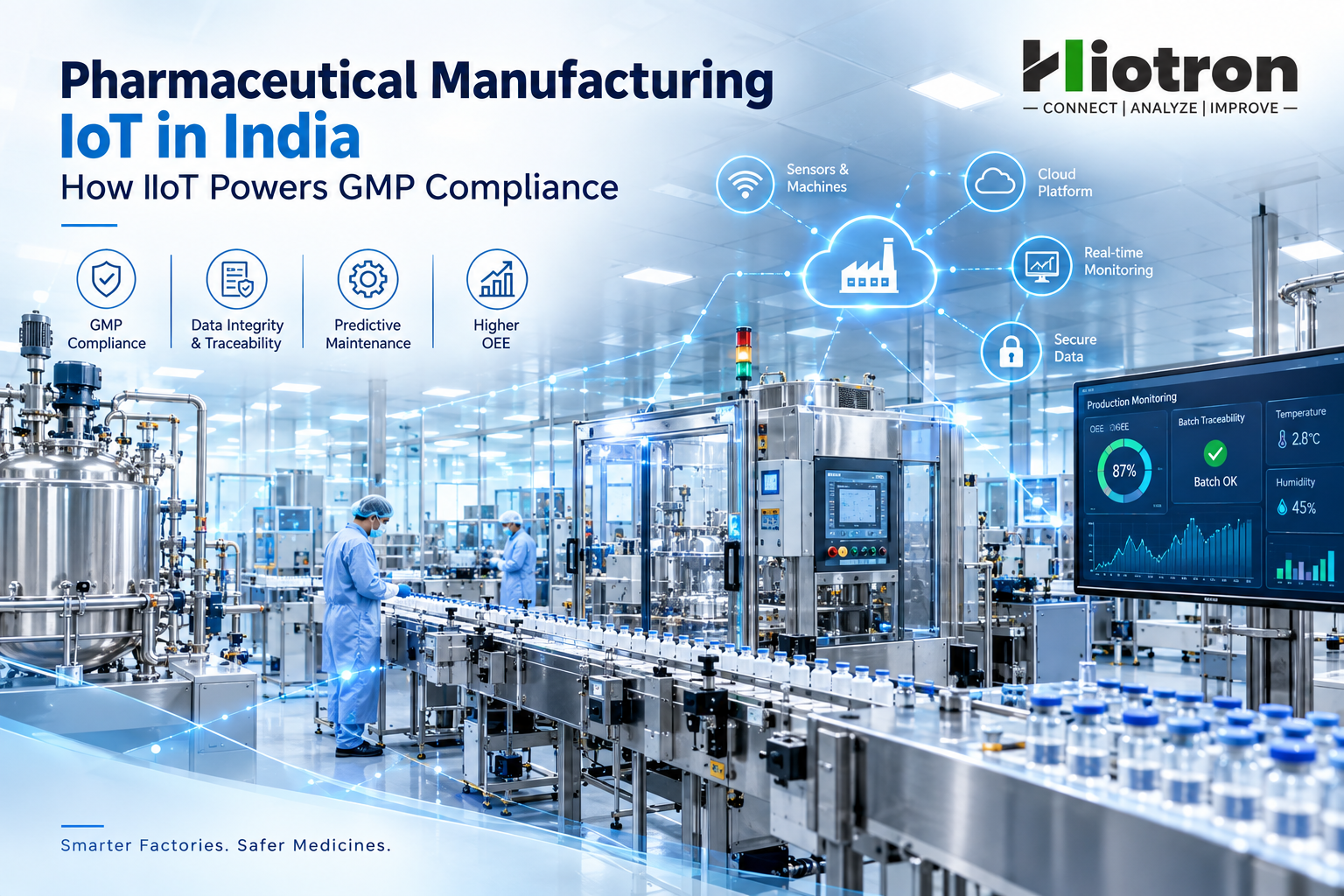
A single missing batch record can hold up a shipment worth crores. A single altered timestamp can trigger an FDA warning letter. For Indian drug makers, pharmaceutical manufacturing IoT India is no longer a technology experiment. It is becoming the most practical way to prove, every minute of every shift, that the plant is running the way the regulator expects.
India’s pharma industry reached about US$ 60 billion in FY26, with exports of roughly US$ 31 billion, according to IBEF. The sector supplies around 20% of the world’s generics by volume. That scale comes with scrutiny. In this guide, we explain how Industrial IoT (IIoT) supports GMP, CDSCO and USFDA expectations, and how pharma plants can also raise OEE while they get audit-ready.
Why GMP Compliance Is Getting Harder for Indian Pharma Plants
Three pressures are landing at the same time: a stricter domestic rulebook, tougher overseas inspections, and thinner margins.
Revised Schedule M leaves no grace period
India’s Revised Schedule M raises the bar on premises, equipment qualification, environmental monitoring and documentation. Large manufacturers with turnover above Rs 250 crore had to comply by June 2024. For MSME manufacturers, the extension window closed on 31 December 2025, and CDSCO has publicly stated that no further extensions will be granted, as reported by IMARC Engineering.
The scale of the gap is striking. India has roughly 10,500 pharmaceutical manufacturing units, and only about 2,000 hold WHO-GMP certification. That leaves more than 8,000 units that need upgrades, according to the same analysis.
Data integrity is the fault line for Indian sites
Overseas regulators care less about whether your process is good and more about whether your records prove it. One industry analysis notes that data integrity issues appear in roughly 60% of FDA warning letters issued to Indian pharma sites, versus about 15% of warning letters globally in FY 2025. Five Indian firms received warning letters in Q1 2026 alone, citing falsified or backdated records, unaddressed out-of-specification results and inadequate batch records (Quality Vigilance).
Manual logbooks, clipboards and spreadsheets are exactly where these failures start. Automation of data capture is the cleanest fix.
What Pharmaceutical Manufacturing IoT Actually Does on the Shop Floor
IIoT connects machines, sensors and utilities to a single data layer. Instead of an operator writing down a value every hour, the system records it automatically, time-stamps it, attributes it and stores it securely. That is the heart of the ALCOA+ principles: data that is Attributable, Legible, Contemporaneous, Original and Accurate, plus Complete, Consistent, Enduring and Available.
Automated, tamper-evident data capture
Gateways read data directly from PLCs, tablet presses, coating pans, granulators, autoclaves, blister packing lines and utilities. Because values flow straight from the equipment, there is no retyping step where errors or manipulation can creep in. Platforms such as FactoryMetrics from hIOTron can retain a full audit trail of every reading and every user action.
Continuous environmental and cold-chain monitoring
Cleanroom differential pressure, temperature, humidity and particle counts are core GMP parameters. IoT sensors monitor them continuously and raise alerts the moment a value drifts toward its limit. The same approach protects warehouses, stability chambers and cold-chain storage for vaccines and biologics.
Electronic batch traceability
When line data, material movement and operator actions are captured together, assembling a batch history takes minutes rather than days. That shortens batch release cycles and makes investigations far easier when a deviation occurs.
Mapping IIoT Capabilities to GMP, CDSCO and FDA Expectations
Compliance teams often ask what, specifically, the technology addresses. The list below pairs each requirement with what IoT can do about it:
- Equipment qualification and calibration: IoT tracks calibration due dates and flags instruments that drift out of tolerance before they compromise a batch.
- Environmental monitoring: Continuous logging with automated alarms replaces periodic manual readings in classified areas.
- Data integrity (ALCOA+): Machine-generated records with user attribution and audit trails reduce reliance on handwritten entries.
- Deviation and OOS handling: Time-stamped process data shows what the equipment was doing when an out-of-specification result appeared.
- Preventive maintenance: Condition monitoring reduces unplanned stoppages in validated equipment, which protects both output and validation status.
- Audit readiness: Searchable, exportable records let QA teams answer inspector questions quickly instead of hunting through binders.
IIoT does not replace your quality system or your validation work. Computerised systems in regulated plants still need proper validation and change control. What it does is give your quality team reliable, complete data to work from.
The Productivity Payoff: GMP and OEE Are Not Opposites
Many plant heads assume compliance work slows production down. In practice, the data you collect for GMP is the same data you need for OEE (Overall Equipment Effectiveness).
A tablet compression line, for example, may lose time to changeovers, cleaning between batches, minor stoppages and slow running. When each of those is captured automatically and tagged with a reason code, patterns become visible. Cleaning validation time, line clearance delays and waiting-for-QA holds are often the largest hidden losses in a pharma plant.
Even a few OEE points on a high-volume line add up quickly, whether the plant makes oral solids, injectables or APIs. That is why compliance and productivity projects are increasingly funded together: one sensor network, one data platform, two returns.
India’s API base makes this especially relevant. The country has over 500 active API producers, about 8% of the global API market (IBEF). Process-heavy batch plants like these depend on tight control of temperature, pressure and hold times, all of which IoT can log and alert on continuously.
There is also a talent angle. QA teams spend a large share of their week reviewing paper records and reconciling logbooks. Automated capture frees them to focus on trend analysis, root-cause work and continuous improvement instead of transcription checks.
Predictive maintenance for validated equipment
Unplanned breakdowns are costly everywhere, but in pharma they carry an extra penalty: a repaired machine may need requalification before it can run again. Vibration and temperature sensors on compressors, chillers, HVAC fans and process motors give early warning, so repairs happen in planned windows.
Energy and utilities under control
Cleanrooms and HVAC systems are power-hungry. Sub-metering by area and equipment shows where energy is being spent and whether air-handling units are running outside their needed schedule, without touching the validated environmental setpoints.
A Practical Roadmap for Pharma Plants in India
- Start with a risk-based scope. Pick the processes where data integrity or environmental excursions carry the highest risk, such as sterile areas, granulation or packaging.
- Digitise read-only first. Use non-intrusive gateways that read from existing PLCs and sensors, so validated machine logic stays untouched.
- Involve QA from day one. Agree on data flows, user roles, audit trails and validation approach before rollout.
- Pilot on one line. Prove the value in 8 to 12 weeks, capture the baseline OEE and deviation rates, then scale plant-wide.
- Secure the network. Segment OT from IT, control user access and log every change. Regulators expect security to be part of data integrity.
Because Indian pharma clusters span Maharashtra, Gujarat, Telangana, Himachal Pradesh and beyond, many plants mix modern lines with older equipment. Retrofit-friendly IoT hardware matters here, since ripping and replacing validated machinery is rarely an option.
Frequently Asked Questions
How does pharmaceutical manufacturing IoT help with GMP compliance?
It automates the capture of process, environmental and equipment data, time-stamps it and keeps an audit trail. That supports ALCOA+ data integrity, faster batch review and quicker deviation investigations.
Is IoT data acceptable to CDSCO and the USFDA?
Regulators care about data integrity and control, not the specific technology. IoT systems used in GxP processes must be validated, have access controls and audit trails, and follow your quality system and change management.
Can we add IoT to older pharma machines without disturbing validation?
Often yes. Read-only gateways and add-on sensors can collect data without modifying machine logic. Any change should still go through your change control and, where needed, risk assessment.
What does Revised Schedule M mean for MSME pharma manufacturers?
MSME units no longer have an extension window, so they need documented compliance on premises, equipment, monitoring and records. Digital monitoring helps close documentation gaps efficiently.
How quickly can a pharma plant see results from IIoT?
A focused pilot on one line or one utility system can show results in roughly two to three months, including baseline OEE, alarm response times and reduced manual logging.
Make Your Pharma Plant Audit-Ready with FactoryMetrics
hIOTron is a Pune-based Industry 4.0 company serving Chemicals & Pharma, Automotive, Aerospace, Electronics, Plastics & Packaging, Heavy Engineering and Process Manufacturing. FactoryMetrics combines plug-and-play IoT hardware, AI-driven analytics and no-code workflow automation, so your team can monitor OEE, equipment health, energy and quality from one platform.
Ready to see it on your own lines? Explore hIOTron’s Industry 4.0 solutions and talk to our team about a pilot.
Sources: IBEF, Indian Pharmaceutical Industry (FY26 market size and exports); IMARC Engineering, India Pharma Compliance Overhaul (Revised Schedule M, unit counts); Quality Vigilance, Indian pharma FDA warning letters Q1 2026. This article is general information and not regulatory or legal advice.