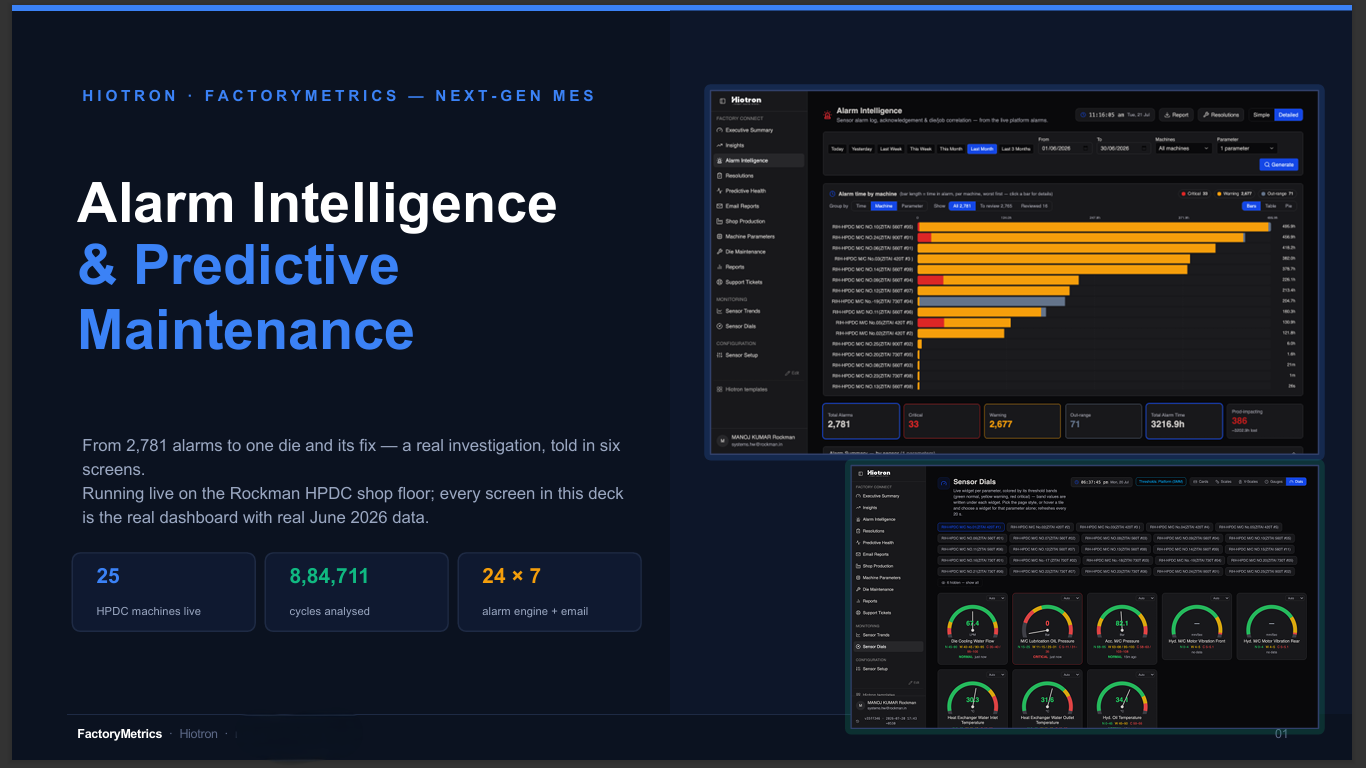
A real Industry 4.0 investigation showing how Hiotron FactoryMetrics
turns thousands of machine alarms into root-cause intelligence,
corrective-action knowledge, machine health monitoring and predictive
maintenance warnings.
Predictive maintenance in manufacturing becomes truly
valuable when a plant can move beyond knowing that an alarm occurred
to understanding which machine needs attention, what is driving
the condition, what fixed it previously, and what may happen next.
Modern factories already generate enormous volumes of machine,
sensor and production data. The bigger challenge is converting that
data into decisions that maintenance and production teams can
actually use.
That is where Hiotron FactoryMetrics moves beyond
conventional machine monitoring.
In a live HPDC shopfloor deployment, FactoryMetrics analysed
884,711 production cycles across 25 machines.
A one-month investigation into Hydraulic Oil Temperature began with
2,781 alarms.
Instead of leaving the maintenance team with thousands of events
to analyse manually, the investigation progressively narrowed the
problem to 33 critical events, four machines and ultimately
one die associated with 29 of those 33 critical events.
The same connected environment then extends further into
corrective-action knowledge, machine-health scoring, parameter
trend analysis and predictive early warnings.
This is the journey from:
Machine Monitoring → Alarm Intelligence → Root-Cause Investigation →
Corrective Action → Machine Health → Predictive Maintenance
What Is Predictive Maintenance in Manufacturing?
Predictive maintenance uses real-time and historical machine
data to identify deterioration and emerging equipment conditions
before they develop into larger failures or production problems.
Traditional preventive maintenance generally operates according
to predefined schedules, machine hours or maintenance intervals.
Predictive maintenance adds another layer by considering the
actual condition and behaviour of the equipment.
However, simply collecting sensor data does not automatically
make a manufacturing operation predictive.
The data needs manufacturing context.
- Which machine generated the abnormal condition?
- Which parameter changed?
- How severe was the event?
- Was production affected?
- Which job, die or tool was running?
- Which other parameters changed around the same time?
- Has this condition happened before?
- What corrective action was previously successful?
- Is the parameter gradually moving toward a warning threshold?
FactoryMetrics brings these different layers together into
one connected manufacturing intelligence environment.
Inside a Live FactoryMetrics Deployment:
25 HPDC Machines and 884,711 Production Cycles
The investigation described in this feature comes from a live
FactoryMetrics implementation on an HPDC manufacturing shopfloor.
The connected environment includes:
- 25 HPDC machines connected live
- 884,711 production cycles analysed
- 24×7 alarm engine and notifications
- Machine and process parameter monitoring
- Configurable warning and critical thresholds
- Production-impact analysis
- Die and job context
- Corrective-action history
- Machine-health analytics
- Parameter trend and drift analysis
- Predictive early warnings
Instead of treating an alarm as an isolated sensor event,
FactoryMetrics connects the alarm with the wider manufacturing
context surrounding it.
Step 1: Turning 2,781 Machine Alarms into a Prioritised Investigation
The investigation started with one parameter:
Hydraulic Oil Temperature.
FactoryMetrics analysed one month of data across all 25 HPDC
machines and detected:
- 2,781 total alarms
- 33 critical alarms
- 2,677 warning alarms
- 71 out-of-range events
- 3,216.9 accumulated hours in alarm conditions
For a maintenance engineer, manually investigating thousands of
events can quickly become impractical.
FactoryMetrics therefore allows the information to be filtered
and analysed by parameters such as machine, severity and alarm
condition.
The operational question changes from:
“How many alarms occurred?”
to:
“Which alarms require our attention first?”
Step 2: Identify Where the Critical Conditions Are Concentrated
Once the dataset was filtered to the most serious events, the
pattern became much clearer.
All 33 critical alarms occurred across only four machines.
The analysis also connected alarm periods with production
behaviour, allowing teams to investigate which events coincided
with production impact.
This is important because alarm count alone does not necessarily
tell a maintenance team which issue matters most.
A frequently occurring warning may have little immediate production
impact, while a smaller number of critical events may point to a
condition requiring urgent engineering attention.
FactoryMetrics therefore helps shift prioritisation from
alarm volume toward severity, context and
manufacturing impact.
Step 3: Trace the Machine Alarm Pattern to the Die
The investigation did not stop at identifying the affected
machines.
FactoryMetrics connected the filtered alarm history with production
cycle and die information.
The result revealed an important concentration:
29 of the 33 critical Hydraulic Oil Temperature events occurred
while die CCCR P-17 D79 was mounted.
The Die/Job Alarm Risk analysis compared 27 dies
against the selected alarm information and production history.
This gives the maintenance team a much more focused path for
investigation.
A conventional alarm system might say:
“Hydraulic Oil Temperature is high.”
A contextual manufacturing intelligence platform can help reveal:
“This critical condition is repeatedly appearing within a specific
production context and is highly concentrated around one die.”
That is a fundamentally different level of information for
maintenance and process teams.
Step 4: Find the Machine Parameters That Move Together
Manufacturing problems rarely exist as isolated sensor readings.
A temperature problem may be related to pressure, flow, cooling,
lubrication or another process condition.
FactoryMetrics therefore analyses co-occurring parameters
around alarm events.
For the Hydraulic Oil Temperature investigation, the platform
examined other events occurring within a ±10-minute window.
The analysis identified repeated co-occurrences including:
- Machine Lubrication Oil Pressure — 85 occurrences
- Molten Metal Temperature — 33 occurrences
- Hydraulic Machine Motor Temperature — 15 occurrences
- Die Cooling Water Flow — 14 occurrences
These relationships do not automatically prove causation.
Instead, they provide engineers with a focused set of related
signals that can support a more efficient root-cause investigation.
Instead of opening hundreds of unrelated trend charts, the
maintenance team can investigate the parameters that repeatedly
appear around the selected alarm condition.
Every Critical Machine Alarm Remains Auditable
Analytics should help simplify an investigation without hiding
the underlying evidence.
FactoryMetrics therefore maintains the detailed event history
behind the analysis.
For the selected Hydraulic Oil Temperature investigation, the
critical log contains all 33 critical events.
Each event can include information such as:
- Machine
- Parameter
- Measured value
- Configured operating limit
- Alarm severity
- Alarm duration
- Production-impact flag
- Acknowledgement status
- Resolution status
- Server-stamped timestamps
This creates a digital trail from:
Detection → Acknowledgement → Investigation → Resolution
For maintenance management, continuous improvement and engineering
review, that history can be as important as the alarm itself.
350 Configured Thresholds Become a Digital Operating Rulebook
Alarm intelligence is only useful when the system understands
what is normal and abnormal for the equipment being monitored.
In this deployment, FactoryMetrics manages
350 configured limits across the 25 HPDC machines.
A monitored parameter can operate across five bands:
- Normal
- Low Warning
- Low Critical
- High Warning
- High Critical
Per-machine overrides can also be configured where different
machines require different operating ranges.
These configured thresholds form the foundation for:
- Alarm severity
- Live status
- Machine-health calculations
- Notifications
- Trend analysis
- Predictive threshold warnings
In effect, the plant’s operating knowledge begins to become part
of the digital manufacturing system itself.
From Alarm Resolution to a Manufacturing Knowledge Base
One of the biggest challenges in industrial maintenance is that
valuable troubleshooting knowledge often remains with individual
engineers and technicians.
A recurring problem may be solved successfully today, but when
the same condition appears months later, another person may need
to investigate the problem again from the beginning.
FactoryMetrics is designed to help preserve that knowledge.
When an alarm is resolved, the platform can record:
- The corrective action taken
- Maintenance remarks
- The person who resolved the event
- Acknowledgement time
- Resolution time
- Machine and parameter context
- Alarm band and condition
The resolution history then becomes part of a growing
corrective-action knowledge base.
Previously successful actions can be included in future suggestions
for the relevant parameter and alarm condition.
The principle is simple:
“What worked the last time this condition occurred?”
Over time, the plant can convert individual troubleshooting
experience into reusable digital manufacturing knowledge.
Moving from Alarm Intelligence to Machine Health Monitoring
Historical alarm investigation explains what has already happened.
Predictive maintenance requires another step: understanding the
current health of the equipment.
FactoryMetrics evaluates monitored parameters against their
configured operating ranges and combines this information into
a machine-health view.
Each machine can receive a health percentage, allowing
assets requiring attention to be surfaced first.
In the live deployment, for example, one machine was shown at
55% health, while other machines were operating at
higher health levels.
The system can also organise machine condition into categories
such as:
- Thermal health
- Hydraulic health
- Mechanical health
Individual parameters are evaluated against their normal,
warning and critical bands and can contribute to the overall
machine-health assessment.
Instead of requiring the maintenance team to inspect every
connected parameter manually, the health layer helps answer:
“Which machine should we look at first?”
Not Just a Health Score: Likely Cause, Supporting Signs and Suggested Action
A health score alone is not enough.
If a dashboard says that a machine is at 55% health, a maintenance
engineer still needs to understand why.
FactoryMetrics therefore connects machine-health information with
the signals contributing to the condition.
In one example from the deployment, the system surfaced:
Cooling water restriction — 55% confidence
The supporting signal included:
Die Cooling Water Flow
The suggested starting action was to inspect the cooling-water
pump, valves and lines for blockage or air and restore the
required flow.
This creates a more actionable maintenance workflow:
Condition → Likely Cause → Supporting Signal → Suggested Action
The purpose is not to replace engineering judgement.
It is to give engineers a better starting point for investigation.
331 Machine and Sensor Parameters Watched in One Environment
Predictive maintenance becomes difficult when engineers need to
open hundreds of separate machine screens and trend charts.
In this FactoryMetrics deployment,
331 live parameter streams are monitored together.
For each machine and parameter combination, the platform can
present:
- Current value
- Status against configured operating band
- Trend direction
- Alarm count
- Short-term behaviour
- Estimated time toward a warning condition
- 30-day drift
- Historical trend
A user can move from a plant-wide view into an individual
parameter and inspect its longer-term history.
This is particularly important for conditions that do not fail
suddenly.
Cooling degradation, fouling, wear, thermal changes and other
process conditions may develop gradually.
Trend and drift analysis helps make that deterioration visible.
Predictive Maintenance with Early Warning and ETA
Traditional alarm monitoring normally reacts when a threshold
has already been crossed.
Predictive monitoring asks a different question:
“If the current behaviour continues, when could this parameter
reach its warning limit?”
FactoryMetrics analyses short-term behaviour together with
longer-term historical drift to provide early-warning indications
and an estimated time toward a configured threshold.
An engineer may therefore see a message such as:
“Warn at 45 in approximately 2 days.”
The system does not need to present this as an unexplained
black-box prediction.
The supporting evidence can include:
- Current reading
- Configured warning threshold
- Recent trend
- 30-day daily-peak drift
- Historical behaviour
- Trend fit information
- Longer-term parameter history
In the deployment, 34 live warnings were presented
with ETA and supporting reasoning.
This gives maintenance teams an opportunity to investigate a
developing condition before it becomes a conventional critical
alarm.
From the Machine Dial to the Maintenance Inbox
Predictive intelligence only creates operational value when the
right people can see and act on it.
FactoryMetrics therefore connects analytics with live shopfloor
monitoring and notification.
In the deployment:
- Live information refreshes approximately every 20 seconds
- Multiple widget styles are available for machine parameters
- Machine-not-running conditions are identified
- Stale data is surfaced rather than shown as a false healthy condition
- Alarm emails can be generated automatically
- Notifications can be scoped by machine and parameter
- Cooldown logic helps reduce repetitive alarm-email storms
This closes an important gap between analytics and action.
The objective is not simply to detect an abnormal condition,
but to make that information available to the people responsible
for responding to it.
From Reactive Maintenance to a Closed Manufacturing Intelligence Loop
When these capabilities work together, predictive maintenance
becomes more than an isolated analytics feature.
It becomes a continuous manufacturing intelligence loop:
MACHINE DATA → ALARM DETECTION → PRODUCTION IMPACT →
ROOT-CAUSE INVESTIGATION → CORRECTIVE ACTION →
RESOLUTION KNOWLEDGE → MACHINE HEALTH →
EARLY WARNING → PREDICTIVE MAINTENANCE
Machine readings provide the raw signals.
Alarm intelligence identifies abnormal conditions.
Production information adds operational impact.
Die, job and process information provide manufacturing context.
Parameter correlation helps narrow investigation.
Corrective actions preserve maintenance knowledge.
Machine-health monitoring prioritises assets.
Historical trends reveal deterioration.
Predictive warnings help teams act earlier.
Each layer makes the next layer more useful.
Predictive Maintenance vs Preventive Maintenance: What Is the Difference?
Preventive maintenance is generally performed
according to predefined schedules, operating hours, cycle counts
or planned maintenance intervals.
Predictive maintenance uses the actual condition
and behaviour of the equipment to identify when attention may
be required.
The two approaches are not necessarily alternatives.
For many manufacturing plants, the strongest maintenance strategy
combines both.
FactoryMetrics can support scheduled preventive activities while
using live condition data, alarms, machine health and historical
trends to add a predictive layer.
This can help maintenance teams move progressively from:
Reactive → Preventive → Condition-Based → Predictive
Why Alarm Intelligence Matters for Manufacturing Plants
Many connected factories already collect large volumes of machine
data.
But more data does not automatically create better decisions.
Manufacturing teams need systems that help answer practical
questions such as:
- Which machines are deteriorating?
- Which alarms are actually affecting production?
- Which parameters repeatedly change together?
- Is a problem connected to a particular tool, die or job?
- What corrective action worked previously?
- Which asset deserves attention first?
- Which parameter is moving toward its warning limit?
The value of Industrial IoT therefore comes not only from
connecting machines, but from converting machine data into
manufacturing context and actionable intelligence.
Which Manufacturing Industries Can Use Predictive Maintenance?
The same connected approach can be valuable wherever machines
generate meaningful operating, condition or process data.
Potential applications include:
- Automotive manufacturing
- Automotive component manufacturing
- HPDC and LPDC casting
- CNC machining
- Forging
- Stamping and press shops
- Injection moulding
- Aerospace manufacturing
- Precision engineering
- Heavy engineering
- Industrial equipment manufacturing
- Heat-treatment equipment
- Furnaces
- Compressors and plant utilities
- Other critical production assets
The exact parameters and prediction approach will depend on the
machine, process and available data.
Can Predictive Maintenance Work with Existing and Legacy Machines?
A manufacturer does not necessarily need to replace existing
equipment to begin building condition-monitoring and predictive
maintenance capabilities.
Depending on the machine, controller and available signals,
FactoryMetrics can connect manufacturing assets using approaches
such as:
- Machine controller interfaces
- PLC communication
- Industrial communication protocols
- Digital I/O
- Additional sensors where required
- Industrial edge connectivity
This makes it possible to build a connected manufacturing layer
across environments containing both modern and legacy equipment.
Why FactoryMetrics Goes Beyond a Conventional Machine Dashboard
A conventional machine dashboard tells you what a machine is
doing.
Hiotron FactoryMetrics is designed to help manufacturing teams
understand what the machine data means and what deserves attention.
FactoryMetrics brings together capabilities including:
- Machine connectivity
- Real-time machine monitoring
- OEE and downtime monitoring
- Process parameter monitoring
- Alarm intelligence
- Production-impact analysis
- Machine-health monitoring
- Root-cause investigation
- Corrective-action history
- Condition monitoring
- Preventive maintenance
- Predictive maintenance
- Trend and drift analysis
- Predictive early warnings
- Quality and process intelligence
- Part and process traceability
- Digital shopfloor workflows
- ERP and manufacturing-system integration
The objective is not to generate more dashboards.
The objective is to help manufacturing teams move from data
to decisions.
Frequently Asked Questions About Predictive Maintenance in Manufacturing
What is predictive maintenance in manufacturing?
Predictive maintenance in manufacturing uses machine condition,
sensor readings, alarms and historical trends to identify
developing equipment problems before they become larger failures
or production disruptions. It helps maintenance teams make
decisions using actual equipment behaviour rather than relying
only on fixed maintenance schedules.
How does FactoryMetrics support predictive maintenance?
Hiotron FactoryMetrics combines live machine parameters, alarm
history, configured thresholds, production context and historical
trends. It can help prioritise abnormal conditions, analyse
parameter drift, evaluate machine health, surface likely causes
and provide early-warning indications when monitored parameters
are moving toward configured limits.
How is alarm intelligence different from basic machine monitoring?
Basic machine monitoring typically shows current machine status
and alarms. Alarm intelligence adds context such as severity,
recurrence, production impact, related parameters, machine
history, tooling or job information and previous resolutions.
This helps manufacturing teams understand which events matter
and where to investigate.
Can FactoryMetrics help identify the root cause of recurring machine alarms?
FactoryMetrics can help narrow root-cause investigations by
correlating alarm events with machine parameters, production
data, tooling or die information, co-occurring parameters and
historical behaviour. In the HPDC example described in this
article, 29 of 33 critical Hydraulic Oil Temperature events were
associated with one die, providing a much more focused path for
engineering investigation.
Can predictive maintenance work with existing machines?
Yes. Predictive-maintenance initiatives do not always require
replacing existing equipment. Depending on the machine and
controller, relevant information may be collected through
controller interfaces, PLCs, industrial communication protocols,
digital signals, additional sensors or industrial edge
connectivity.
What machine parameters can be monitored for predictive maintenance?
The available parameters depend on the equipment and manufacturing
process. Examples can include temperature, pressure, flow,
vibration, motor conditions, hydraulic parameters, lubrication
conditions, cycle behaviour and other machine or process signals
available through the machine or connected sensors.
What is machine health monitoring?
Machine health monitoring evaluates relevant machine and process
parameters to create a simplified view of equipment condition.
FactoryMetrics can evaluate parameters against configured normal,
warning and critical bands and organise health information into
areas such as thermal, hydraulic and mechanical condition.
What is an estimated time to threshold in predictive maintenance?
Estimated time to threshold indicates when a trending machine
parameter may reach a configured warning level if the observed
behaviour continues. It provides maintenance teams with an
additional planning signal before the threshold is actually
crossed.
Does predictive maintenance replace preventive maintenance?
No. Predictive and preventive maintenance can complement each
other. Preventive maintenance provides structured scheduled
activities, while predictive maintenance adds condition-based
intelligence using actual machine behaviour and historical
trends.
Can FactoryMetrics monitor multiple machines and parameters at the same time?
Yes. In the live HPDC deployment discussed in this article,
FactoryMetrics monitors 331 parameter streams across 25 connected
machines, allowing teams to review machine condition, alarms,
trends and potential warning conditions from a common environment.
What is the difference between condition monitoring and predictive maintenance?
Condition monitoring focuses on observing the current and
historical condition of equipment. Predictive maintenance builds
on that information by analysing trends and deterioration patterns
to identify emerging conditions and help estimate when attention
may be required.
How can IIoT improve predictive maintenance?
Industrial IoT helps connect machines, controllers and sensors so
that relevant operating information can be collected continuously.
When this data is combined with manufacturing context, alarm
history, configured limits and analytics, it can support
condition monitoring, root-cause investigation and predictive
maintenance workflows.
From Machine Data to Predictive Manufacturing Intelligence
Manufacturers already generate enormous volumes of machine and
process data.
The opportunity is to transform that information into
earlier detection, faster investigation and better
maintenance decisions.
The FactoryMetrics deployment described in this feature
demonstrates that progression clearly:
2,781 alarms → 33 critical events → 4 machines →
29 critical events associated with one die →
related parameter investigation → corrective-action knowledge →
machine-health monitoring → predictive early warnings.
What begins as machine connectivity can progressively become
a manufacturing intelligence layer.
With Hiotron FactoryMetrics, manufacturers can
bring machine connectivity, alarm intelligence, production
context, condition monitoring, maintenance knowledge and
predictive analytics into one connected manufacturing platform.
Connect. Detect. Diagnose. Resolve. Learn. Predict.
That is the shift from simply monitoring machines to
understanding them.
Explore Predictive Maintenance with Hiotron FactoryMetrics
If your manufacturing plant is already collecting machine data
but still depends heavily on manual alarm analysis, reactive
troubleshooting or disconnected maintenance information,
FactoryMetrics can help turn that data into actionable
manufacturing intelligence.
Explore how Hiotron FactoryMetrics can support
machine connectivity, OEE, downtime, traceability, quality,
maintenance and predictive manufacturing intelligence across
your shopfloor.
Explore Hiotron FactoryMetrics →
Explore more Industry 4.0 & Smart Manufacturing insights →
Hiotron FactoryMetrics | Connect. Analyze. Control.