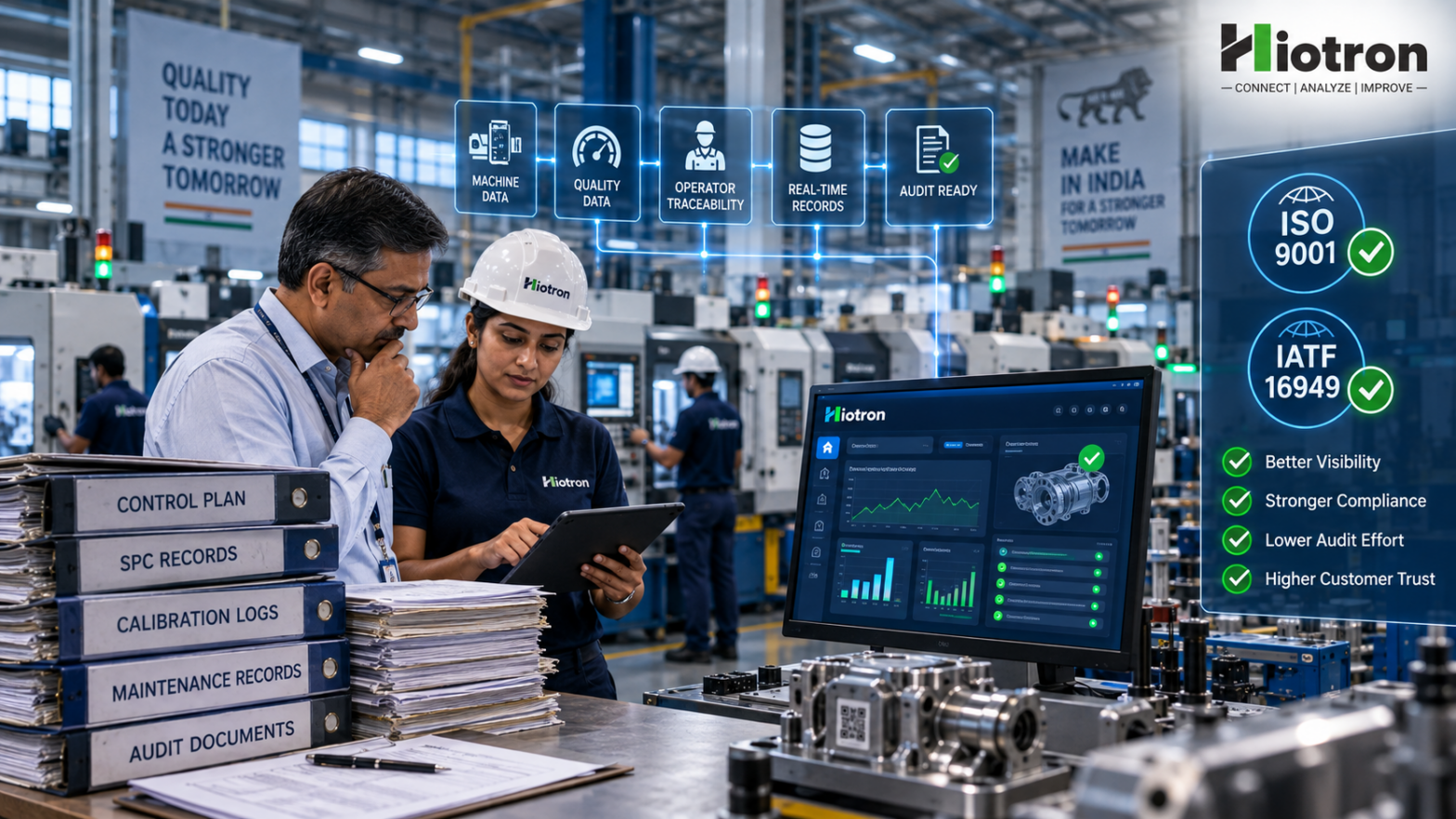
Every quality head in an Indian auto-component plant knows the week before an IATF 16949 surveillance audit. Binders come out of cupboards. Operators are asked to “find” last quarter’s SPC charts. Someone reconstructs a calibration log from memory. It proves very little about how the line actually ran on a night shift in March.That is the gap manufacturing quality compliance IoT in India is now closing. When machines, gauges and inspection stations stream data into a single platform, the audit trail writes itself, control plans become live monitors, and the standard stops being a document and starts being a behaviour. With ISO 9001 being revised in 2026 and a new edition of IATF 16949 expected soon after, the timing for Indian manufacturers could not be better.
Why Quality Compliance Is Getting Harder for Indian Manufacturers
India’s auto-component industry has never been bigger or more exposed. According to ACMA, the sector posted a record turnover of INR 7.59 lakh crore (about USD 85.9 billion) in FY2025-26, up 12.7% year on year, with exports of roughly USD 24 billion and Europe as the fastest-growing destination. Every one of those export contracts comes with a customer-specific requirement sheet, a PPM target and a scorecard.
The certification base is huge too. VDA QMC reports more than 93,000 IATF 16949 certified sites worldwide, and India is one of the fastest-growing contributors to that number. Certification under the IATF Rules 6th Edition is now a baseline expectation from Tata Motors, Maruti Suzuki, Mahindra, Stellantis and Volkswagen alike. Certification alone no longer differentiates a supplier.
The cost of poor quality is still enormous
The American Society for Quality estimates that quality-related costs run at 15% to 20% of sales revenue at many manufacturers, and as high as 40% of operations at the worst performers. World-class plants keep total cost of poor quality below 5%. For a Pune Tier-2 supplier with INR 200 crore turnover, the difference between “typical” and “world-class” is INR 20 to 30 crore a year, more than most of them spend on their entire quality department.
There is good news in the numbers as well. Vehicle recalls in India fell to 1,19,173 units in 2025, the lowest level in eight years, and industry observers credit tighter quality audits and stronger internal monitoring. Manufacturers that instrument their processes are the ones pulling those numbers down.
What ISO 9001 and IATF 16949 Actually Ask For (and Where Paper Fails)
Strip away the clause numbers and the automotive standard asks for four things: evidence that you control your processes, evidence that you measure and react, evidence that product can be traced, and evidence that you improve. Paper and spreadsheets can satisfy all four, but only after the fact, and only if someone remembered to fill them in.
Control plans and SPC (IATF 8.5.1.1, 9.1.1.1)
The control plan says you monitor a critical dimension every 30 minutes with a CpK target of 1.33. On paper, an operator writes five readings on a chart. In practice, a busy shift skips a sample, a chart is backfilled, and a drift that started at 2 a.m. is discovered at the 8 a.m. review. An IIoT-connected gauge records every reading with a timestamp and machine ID. The platform calculates CpK continuously and alerts the shift leader the moment the process drifts, before a single non-conforming part is boxed.
Traceability and identification (IATF 8.5.2.1)
Auditors increasingly test traceability by picking one part and asking for its full history: which machine, which operator, which raw-material lot, which tool, which inspection result. A digital thread built from machine data and scanned lot IDs answers that question in seconds. A paper system answers it in hours, if at all.
Calibration, maintenance and total productive maintenance (IATF 7.1.5, 8.5.1.5)
Calibration due dates, preventive maintenance completion and MTBF/MTTR records are the classic “last week before the audit” scramble. When maintenance tasks are triggered from run hours and sensor data, and closed out on a tablet at the machine, the record exists because the work happened, not because someone remembered to write it down.
How Manufacturing Quality Compliance IoT Works in Practice
A quality compliance IoT deployment does not replace your QMS. It feeds it. Here is the typical architecture we see in Indian plants that have done this well.
- Machine connectivity: Plug-and-play edge gateways connect CNCs, presses, moulding machines and test rigs over OPC UA, Modbus or direct I/O, and stream cycle data, alarms and parameters without touching the PLC program.
- Quality data capture: Digital gauges, vision systems and manual inspection screens replace paper check sheets, so every measurement carries who, what, when and where.
- Edge processing: SPC calculations, reaction plans and interlocks run locally on the edge so that a network outage never creates a compliance gap.
- Central platform: A cloud or on-premise platform such as hIOTron’s FactoryMetrics stores the records immutably, links them to part numbers and lots, and builds the dashboards and audit reports.
- No-code workflows: When a reading goes out of control, the platform raises a non-conformance, notifies the right people on WhatsApp or email, and holds the lot until disposition, all without a line of code.
Are digital records acceptable to auditors?
Yes, and this is the question we hear most often from Indian quality heads. Digital quality records are accepted as equivalent to paper for ISO 9001, IATF 16949, AS9100 and FDA audits, provided the system maintains an audit trail, supports authenticated electronic signatures and can produce complete printed copies on request. Post-COVID, remote and AI-assisted audit methods have gained formal acceptance, and the ISO 9001:2026 revision explicitly addresses data integrity for digital manufacturing, digital twins and MES/ERP traceability. A platform designed for manufacturing compliance meets these requirements by default.
The Business Case: Same-Shift Data Beats Next-Day Data
The compliance benefit is real, but plant heads rarely fund a project to make auditors happier. They fund it because the same data reduces scrap, rework and customer complaints. Industry analysis of automotive Tier-1 suppliers has found that facilities where quality data enters the management system within the same production shift consistently outperform facilities relying on next-day or weekly entry on corrective-action closure time, repeat escape rate and customer scorecard performance.
In our own work with automotive, electronics and plastics manufacturers in Maharashtra, Gujarat and Tamil Nadu, the pattern is consistent. Once SPC moves from paper to live monitoring, first-pass yield typically improves by two to five percentage points within two quarters, and time spent preparing for customer and certification audits drops by 60% to 80%.
What the numbers look like for a mid-sized Indian plant
- Audit preparation: from roughly 15 person-days per surveillance audit to under 3, because reports are generated rather than assembled.
- Customer PPM: a typical move from 150 to 200 PPM down to 50 to 80 PPM as real-time SPC catches drift before parts ship.
- Scrap and rework: best-in-class plants hold scrap and rework below 0.6% of revenue against a median of around 1.4%. Closing even half that gap on INR 200 crore turnover is worth INR 80 lakh a year.
- Corrective-action closure: 8D cycle time shrinks because root-cause data (machine parameters at the time of the defect) is already captured.
Beyond Automotive: Pharma, Aerospace, Electronics and Process Industries
Automotive suppliers feel IATF pressure most acutely, but the same IIoT compliance pattern applies across the industries hIOTron serves. Aerospace suppliers working to AS9100 need the same traceability and special-process records. Electronics manufacturers chasing IPC standards need solder-profile and ESD data logged automatically. Pharma and chemical plants working under Schedule M, WHO-GMP and FDA 21 CFR Part 11 need environmental monitoring and batch records with electronic signatures. Plastics and packaging converters supplying FMCG brands face increasingly strict hygiene and material traceability requirements.
The regulatory language differs, but the underlying requirement is identical: prove, with time-stamped evidence, that the process ran inside its limits. One platform that captures machine, environmental and inspection data can serve all of these standards, which matters for Indian groups that run automotive, engineering and consumer businesses under one roof.
A Practical Roadmap for Indian Plants
Step 1: Map the standard to the data you already generate
Take your control plans and list every characteristic that is currently recorded by hand. Most plants find that 60% to 70% of those readings are already being measured by a machine, a gauge or a test rig; they just are not being captured. Those are the quick wins.
Step 2: Start with one line and one customer
Pick the line supplying your most demanding OEM or export customer. Connect the machines, digitise the check sheets, and run live SPC for one quarter. Use that customer’s next scorecard review as the proof point.
Step 3: Automate reaction plans, not just records
A record that says a process drifted is compliance. An alert that stops the drift is quality. Configure no-code workflows so that out-of-control conditions trigger holds, notifications and non-conformance reports automatically.
Step 4: Build the audit pack as a standing report
Configure dashboards that mirror the auditor’s checklist: SPC summaries by characteristic, calibration status, maintenance completion, traceability lookups and open corrective actions. When the auditor arrives, you open a screen instead of a cupboard.
Step 5: Prepare for the 2026-27 standard revisions
ISO 9001 is being revised in 2026, and the next edition of IATF 16949 is in drafting, with publication expected in late 2026 or early 2027. Early signals point to heavier emphasis on data integrity, software quality, cybersecurity alignment with ISO/SAE 21434 and supply-chain resilience. Plants that already hold their quality data digitally, with audit trails and access control, will find the transition far easier than plants still relying on paper.
Frequently Asked Questions: Quality Compliance IoT in Indian Manufacturing
Does IATF 16949 allow IoT-based digital records instead of paper check sheets?
Yes. IATF 16949 and ISO 9001 require documented information to be controlled, retrievable and protected; they do not mandate paper. Digital records from an IIoT platform are accepted provided there is an audit trail, controlled access and the ability to produce complete copies during an audit. Many certification bodies in India now conduct partially remote audits using exactly this kind of data.
How does IoT help with SPC requirements for Indian automotive suppliers?
Connected gauges and machine sensors capture every measurement automatically, so sample frequency in the control plan is always met. The platform calculates Cp, CpK and control limits continuously and alerts operators when a process drifts, which turns SPC from a retrospective chart into a real-time control tool. This directly reduces customer PPM and supports IATF clause 9.1.1.1.
What is the cost of implementing quality compliance IoT in an Indian SME plant?
Costs vary with machine count and the number of inspection points, but plug-and-play gateways and subscription-based platforms have brought entry costs down significantly. A single-line pilot covering 8 to 12 machines with digital inspection typically pays back within 9 to 14 months through reduced scrap, rework and audit preparation time, before counting the value of retained customer business.
Can one IoT platform support ISO 9001, IATF 16949, AS9100 and GMP compliance together?
Yes, if it is designed for manufacturing data rather than generic document control. The same time-stamped machine, environmental and inspection records serve automotive, aerospace, electronics and pharma standards; what differs is the reporting layer. Indian groups with multiple business verticals benefit most from a single platform with configurable reports per standard.
Will IIoT quality data help with the upcoming ISO 9001:2026 and IATF 16949 revisions?
The upcoming revisions place greater emphasis on data integrity, digital traceability across MES and ERP systems, and cybersecurity. Plants that already capture quality data digitally, with controlled access and audit trails, will meet these expectations with configuration changes rather than a new system.
Turn Compliance from a Cost Centre into a Competitive Edge with FactoryMetrics
Indian manufacturers are winning export business on cost and capability. Keeping it depends on proving quality every day, not once a year. FactoryMetrics from hIOTron combines plug-and-play IoT hardware, real-time SPC and quality analytics, and no-code workflow automation so that ISO 9001, IATF 16949 and GMP evidence is generated by the process itself. Built in Pune and deployed across automotive, aerospace, electronics, pharma, plastics and heavy engineering plants, it gives quality heads live control and gives auditors the data they ask for in seconds.
Explore FactoryMetrics and book a compliance-readiness demo for your plant. Bring your control plan; we will show you how much of it can be live within 30 days.