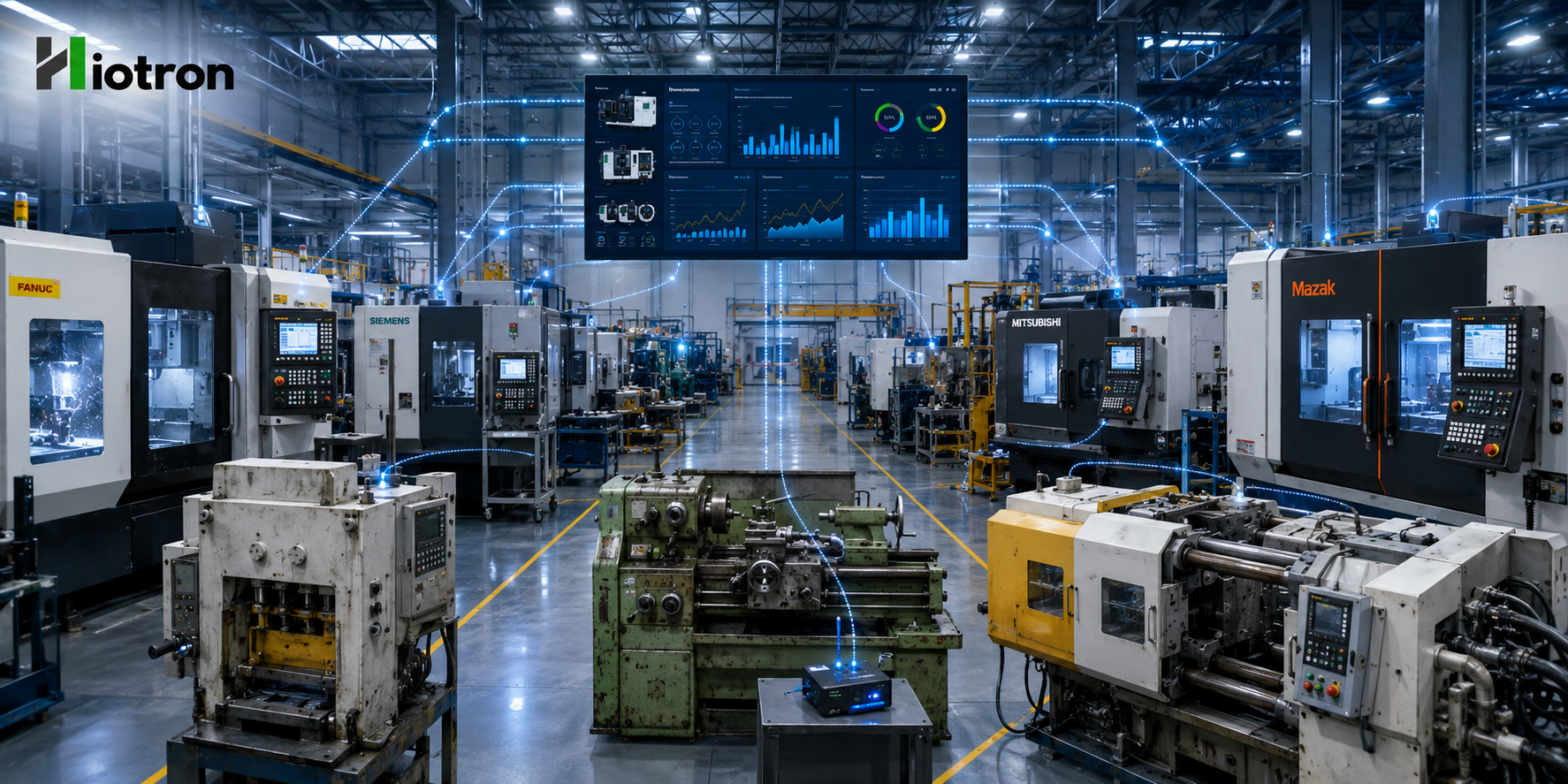
Manufacturing plants rarely operate with one machine brand or one controller ecosystem.
A typical shopfloor may include FANUC CNCs, Siemens-controlled machines, Mitsubishi or Allen-Bradley PLCs, Mazak equipment, presses, die-casting machines, furnaces and older machines that were never designed for Industry 4.0.
The challenge is simple:
How do you connect all these machines to one digital manufacturing platform?
This is where Hiotron FactoryMetrics provides a practical machine-connectivity layer for modern and brownfield factories.
Hiotron positions FactoryMetrics as an end-to-end manufacturing data collection, processing and analytics platform, with 3,000+ machines connected across 154 factories in the referenced FactoryMetrics deck.
Why Machine Connectivity Is the Foundation of Industry 4.0
- Before a manufacturer can calculate OEE, analyze downtime, predict maintenance requirements or build traceability, reliable data must first come from the shopfloor.
- But every machine exposes data differently.
- Some provide controller-level communication.
- Some communicate through industrial protocols.
- Others provide PLC signals.
- Older equipment may offer only digital electrical signals.
This means Industry 4.0 connectivity cannot depend on one communication method for every machine.
FactoryMetrics is designed to select the appropriate connectivity approach based on the machine, controller and data requirement.
How FactoryMetrics Connects Machines
A simplified FactoryMetrics architecture looks like this:
Machine / CNC / PLC
→ Controller Protocol or Digital I/O
→ Hiotron DIOT Edge Layer
→ FactoryMetrics IoT Platform
→ Dashboard, Analytics & Manufacturing Intelligence
→ ERP / Enterprise Systems
The FactoryMetrics deck identifies the DIOT Box as the IoT gateway between machine/controller environments and the platform.
1. Direct Controller Connectivity
Where supported, FactoryMetrics communicates directly with the CNC controller or PLC.
Documented connectivity approaches include:
- FANUC – FOCAS
- Siemens – OPC
- Modbus
- MTConnect
- Ethernet-based communication
Depending on the machine, this can provide information such as:
- Production count
- Machine utilization
- Program number
- Alarms
- Tool-related information
The exact information depends on the controller and machine configuration.
2. Legacy Machine Connectivity
Older equipment should not automatically be excluded from digitalization.
Where protocol-level connectivity is not available, FactoryMetrics can use 24V digital I/O signals.
For example:
Cycle Start + Cycle Stop = Production Cycle
Where suitable signals are available, spindle status can also support machine utilization monitoring.
This approach enables manufacturers to extract meaningful operational information from equipment that may have been installed long before Industry 4.0.
Controllers Supported Across the Factory
Hiotron has documented experience communicating with multiple controller environments, including:
FANUC, Siemens, Mitsubishi, Mazak, Makino, Brother, HAAS, Allen-Bradley, Schneider, Delta and Yokogawa.
The advantage is not simply controller compatibility.
It is the ability to bring machines from different ecosystems into one common manufacturing intelligence platform.
What Types of Machines Can Be Connected?
FactoryMetrics is not limited to CNC monitoring.
The Hiotron deployment portfolio includes equipment such as:
- CNC and Swiss CNC machines
- Horizontal and vertical mills
- Lathes and mill-turn machines
- HPDC and LPDC machines
- Injection moulding machines
- Presses and press brakes
- Laser cutting equipment
- Robotic welders and robotic arms
- Heat-treatment equipment
- Furnaces
- Compressors
- Waterjets
- Wire EDM
- Custom manufacturing equipment
The FactoryMetrics deck documents a broad range of connected equipment across machining, forming, casting, robotics and process environments.
Does FactoryMetrics Require Kepware?
FactoryMetrics is built as an end-to-end Hiotron architecture and does not make a separate Kepware licence the mandatory foundation for machine connectivity.
This does not mean that FactoryMetrics avoids OPC.
For example, Hiotron documents OPC connectivity for Siemens environments.
The difference is that FactoryMetrics can use the appropriate industrial interface directly within its broader architecture without requiring every deployment to be designed around an additional licensed middleware layer.
This can simplify connectivity for plants operating large numbers of heterogeneous machines.
What Happens After the Machine Is Connected?
Connectivity itself is only the first step.
Once machine data reaches FactoryMetrics, manufacturers can use the same platform for:
- Real-time production monitoring
- OEE and utilization
- Downtime analysis
- Cycle-time monitoring
- Machine alarms
- Preventive and predictive maintenance
- Quality monitoring
- Part and process traceability
- Energy monitoring
- Digital documents and SOPs
- ERP integration
- AI/ML-driven manufacturing insights
These capabilities are part of the broader FactoryMetrics manufacturing platform documented by Hiotron.
The journey therefore becomes:
Machine → Data → Analytics → Manufacturing Intelligence → Action
Why This Matters for Brownfield Manufacturing
Consider a factory with:
- FANUC CNCs
- Siemens machines
- Mitsubishi equipment
- Old presses
- Die-casting machines
- Furnaces
- Custom machinery
Replacing all of these machines simply to create a connected factory would rarely make economic sense.
A more practical approach is to use the right connection method for each asset while bringing all available data into one common platform.
One machine may use FOCAS.
Another may use OPC.
Another may use Modbus.
An older machine may use digital I/O.
The connectivity method can change. The manufacturing intelligence layer does not have to.
Conclusion
Industry 4.0 does not require every machine on the shopfloor to speak the same language.
It requires a connectivity architecture capable of working with the machines already installed.
Through controller protocols, PLC communication, digital I/O and the Hiotron DIOT edge layer, FactoryMetrics helps bring modern and legacy manufacturing equipment into one connected digital environment.
The objective is not simply to connect more machines.
It is to make machine data useful for production, quality, maintenance, traceability and better manufacturing decisions.
Connect. Analyze. Control.
Frequently Asked Questions
Can FactoryMetrics connect legacy machines?
Yes. Depending on the equipment, Hiotron can evaluate controller-level communication or alternative methods such as digital I/O for production and utilization data.
Which controllers can FactoryMetrics communicate with?
The FactoryMetrics deck documents experience with FANUC, Siemens, Mitsubishi, Mazak, Makino, Brother, HAAS, Allen-Bradley, Schneider, Delta and Yokogawa.
Which protocols does FactoryMetrics support?
Documented approaches include FANUC FOCAS, OPC, Modbus, MTConnect and 24V digital I/O.
Does FactoryMetrics require Kepware?
A separate Kepware licence is not presented as a mandatory part of the FactoryMetrics architecture. OPC may still be used where appropriate.
Can different machine types be monitored on one platform?
Yes. FactoryMetrics is designed for mixed-machine manufacturing environments containing different controllers, equipment types and connectivity methods.