A single unplanned breakdown on a production line can cost an Indian manufacturer lakhs of rupees in lost output, overtime, and rushed spare-part logistics — and most plants only find out something was wrong after the machine has already stopped. Machine learning manufacturing India deployments are changing that equation by reading sensor data continuously and flagging failures days or weeks before they happen. Globally, the predictive maintenance market reached $14.29 billion in 2025 and is on pace to cross $50 billion in 2026, growing at a 28.6% CAGR — yet only 27% of manufacturers are actually using it today. That gap between opportunity and adoption is exactly where Indian plant managers now have a chance to get ahead of competitors still relying on calendar-based servicing and gut instinct.
This piece breaks down how machine learning actually predicts equipment failure, what results Indian manufacturers are seeing, and how to start without a data science team on payroll.
Why Machine Learning Is Becoming Core to Intelligent Manufacturing in India
India’s AI-in-manufacturing market is projected to reach roughly $4.89 billion by 2030, growing at a 41.5% CAGR, and the broader machine learning market in the country is expected to hit $17.87 billion by 2030. That growth is not evenly spread. The automotive sector leads the shift, using AI and ML to streamline assembly-line throughput and cut rework, while pharmaceutical manufacturers are close behind, applying it to production-line efficiency and batch quality. Electronics manufacturers riding the PLI (Production Linked Incentive) wave are adopting AI-driven process control to hit the tighter tolerances demanded by global buyers.
What ties these industries together is intelligent manufacturing India initiatives built on the same foundation: continuous sensor data feeding models that learn what “normal” looks like for a specific machine, so they can flag the first signs of drift toward failure. This is a very different approach from traditional SCADA alarms, which only trigger once a threshold has already been breached.
How Machine Learning Actually Predicts Equipment Failure
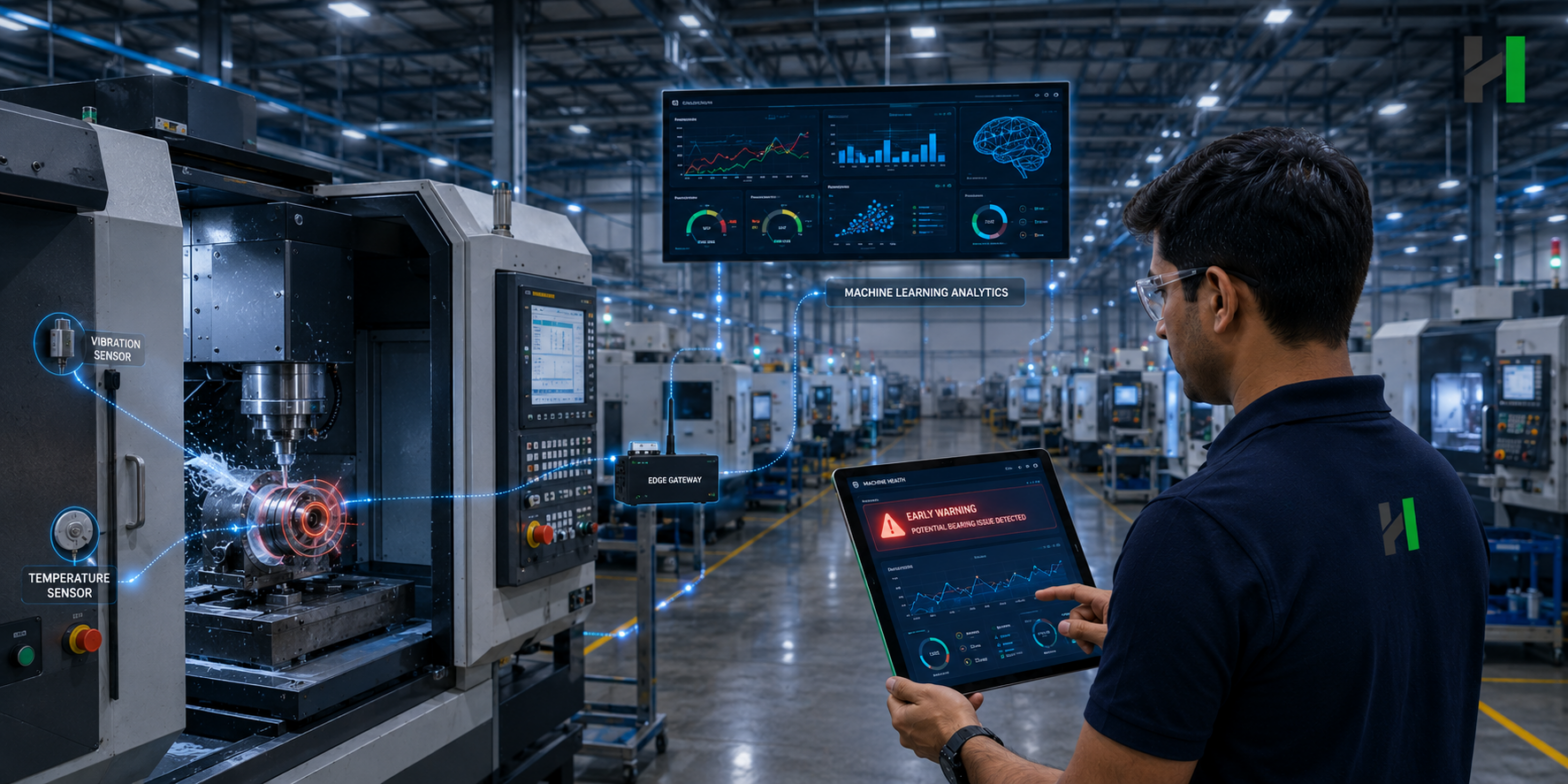
Predictive maintenance models don’t guess — they learn from patterns in vibration, temperature, current draw, acoustic signatures, and historical failure logs. Once trained, the model scores incoming sensor readings against what it has learned and raises a flag when the pattern resembles the early stages of a known failure mode.
Data Collection at the Edge
IIoT sensors attached to motors, bearings, compressors, and CNC spindles stream readings every few seconds. Edge gateways pre-process this data locally, reducing bandwidth costs and enabling near-real-time scoring even on factory floors with unreliable connectivity — a common constraint in Tier 2 and Tier 3 Indian industrial clusters.
Model Training and Anomaly Detection
Supervised models are trained on labeled historical failures where available; unsupervised anomaly detection is used when failure history is sparse, which is common for newer plants. Both approaches converge on the same output: a risk score per asset, updated continuously.
From Alert to Action
A risk score is only useful if it reaches the right person with enough lead time to act. This is where hIOTron‘s FactoryMetrics platform closes the loop — automatically routing high-risk alerts into maintenance work orders via no-code workflows, so plant teams aren’t buried in raw dashboards they don’t have time to interpret.
Real-World Impact: Downtime, Costs, and Asset Life
The numbers behind AI-driven predictive maintenance are hard to ignore. Manufacturing facilities fully utilizing AI-driven predictive maintenance report a 30% to 50% reduction in total machine downtime and a 20% to 40% extension in the remaining useful life of critical assets. Separately, manufacturers using machine learning for predictive maintenance report up to a 50% reduction in unplanned downtime and 10–40% savings on maintenance costs overall.
It’s worth being honest about the ramp-up: getting a model to the 88–93% recall and under-5% false-positive rate that maintenance teams will actually trust typically takes 4 to 6 months of disciplined iteration. Manufacturers who treat this as a quick plug-and-play win often abandon the effort too early — the payoff comes after the model has seen enough real operating cycles to separate genuine risk from noise.
Where It Matters Most in Indian Plants
In automotive component manufacturing, ML-based condition monitoring on stamping presses and robotic welders prevents the kind of line stoppage that cascades into missed OEM delivery windows. In process manufacturing and chemicals, it catches pump and compressor degradation before a failure risks a safety incident. In electronics assembly, it protects high-precision equipment where even small calibration drift produces defective boards.
AI Predictive Analytics vs. Traditional Preventive Maintenance
AI predictive analytics manufacturing India programs differ fundamentally from the preventive maintenance schedules most plants still run on. Preventive maintenance services equipment on a fixed calendar, regardless of actual condition — which means healthy parts get replaced early (wasting money) and struggling parts sometimes fail between scheduled checks (causing downtime anyway).
Machine learning flips this to condition-based servicing: maintenance happens when the data says it’s needed, not when the calendar says so. For Indian manufacturers balancing tight margins with the cost of imported spare parts, this shift alone can materially change maintenance budgets, since parts are replaced only when genuinely nearing end-of-life rather than on an arbitrary interval.
Getting Started with ML-Driven Manufacturing Without a Data Science Team
The biggest myth blocking adoption among Indian SMEs is that machine learning requires an in-house data science function. It doesn’t. Platforms like FactoryMetrics ship with pre-trained models for common failure modes across motors, bearings, and rotating equipment, paired with plug-and-play IIoT hardware that installs without rewiring the plant floor.
That matters because funding and skills remain real constraints: only around 30% of Indian SMEs have adequate access to financing for this kind of technology investment, and demand is currently outpacing the supply of ML specialists who also understand manufacturing domain context. A practical starting point looks like this:
- Start with your highest-cost failure point — the single machine or line where unplanned downtime hurts most, not the whole plant at once.
- Instrument before you model — install vibration, temperature, and current sensors and collect 4–8 weeks of baseline data before expecting accurate predictions.
- Use no-code workflow automation to route alerts into your existing maintenance process instead of building a new one from scratch.
- Measure against a baseline — track downtime, maintenance cost, and OEE for at least one quarter before and after to quantify ROI.
- Expand line by line once the first deployment proves out, rather than attempting a plant-wide rollout on day one.
The Make in India Angle: Why This Is a Competitiveness Issue, Not Just an IT Upgrade
Global automotive and electronics buyers increasingly audit suppliers on quality consistency and delivery reliability — both of which are directly improved by fewer unplanned stoppages. As AI and machine learning are projected to be the fastest-growing segment within industrial analytics through 2033, at a 27.2% CAGR, Indian manufacturers who delay adoption risk falling behind competitors in Vietnam, Mexico, and China who are already instrumenting their lines. For plants exporting under PLI-linked programs, demonstrable process control powered by ML IoT manufacturing is fast becoming a differentiator in supplier audits, not just an internal efficiency play.
Frequently Asked Questions
How much does machine learning for manufacturing cost for a small Indian factory?
Entry-level deployments on a single production line typically start with sensor hardware costs plus a subscription for the analytics platform. Plug-and-play IIoT platforms like FactoryMetrics reduce upfront cost by avoiding custom integration work, making single-line pilots accessible even for SMEs with limited capital budgets.
How long does it take to see results from machine learning predictive maintenance?
Most manufacturers see the model reach reliable accuracy (88–93% recall with low false positives) within 4 to 6 months of continuous data collection and tuning. Some anomaly detection benefits appear earlier, but trustworthy failure prediction needs enough operating cycles to learn from.
Do I need a data science team to implement AI predictive analytics in manufacturing?
No. Pre-built IIoT and analytics platforms come with trained models for common industrial failure modes, so plant engineers can configure and run them without hiring dedicated data scientists.
Which industries in India benefit most from machine learning manufacturing solutions?
Automotive, pharmaceuticals, electronics, and process manufacturing (chemicals) are currently seeing the fastest returns, largely because they combine high equipment costs, tight tolerances, and regulatory or OEM quality pressure.
Is machine learning predictive maintenance only useful for large factories?
No. While large plants have adopted it first, no-code and plug-and-play platforms have made single-line and SME deployments increasingly practical, especially for manufacturers who start with one critical asset rather than a plant-wide rollout.
Turn Sensor Data Into Predictions With FactoryMetrics
Machine learning manufacturing India adoption is no longer a question of if — it’s a question of which plants move first and capture the downtime, cost, and quality advantages before competitors do. hIOTron‘s FactoryMetrics platform combines plug-and-play IIoT hardware, pre-trained predictive models, and no-code workflow automation to help manufacturers across automotive, aerospace, electronics, chemicals & pharma, plastics & packaging, heavy engineering, and process manufacturing move from reactive repairs to predictive operations — without needing an in-house data science team.
Explore how FactoryMetrics can be deployed on your production line at hIOTron’s Industry 4.0 Solutions page.