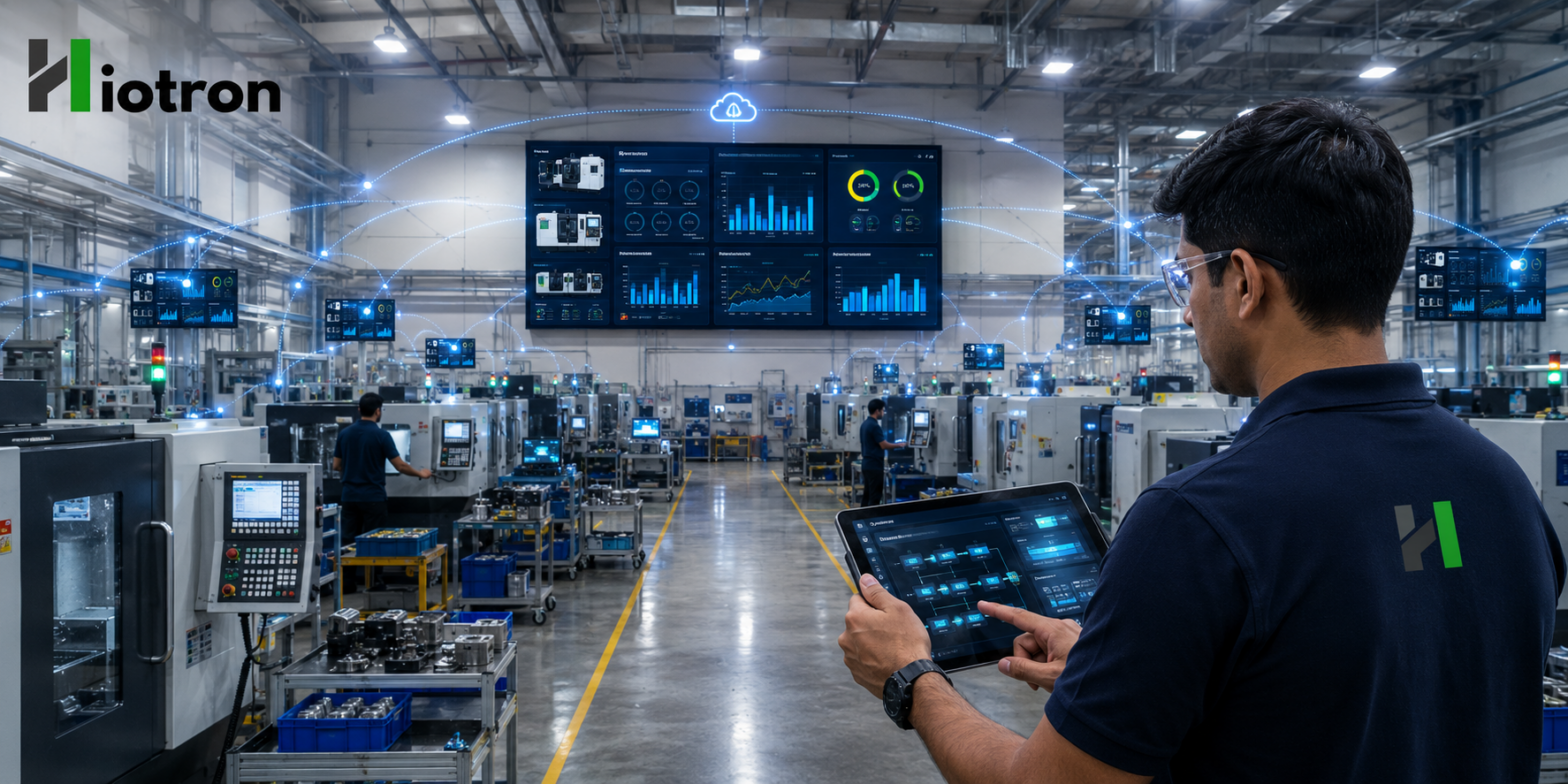
No-code IoT in manufacturing in India is quietly doing what a decade of expensive integration projects could not: putting Industry 4.0 within reach of the 200-employee auto component shop in Chakan, the injection moulding unit in Vasai, and the pharma packaging line in Baddi. For years, the story was the same — a small manufacturer would get an IIoT proposal, see a six-month integration timeline and a line item for “custom development,” and quietly shelve it. Meanwhile, the tier-1 supplier down the road was already running live OEE dashboards.
That gap is closing fast. The low-code and no-code platform market is estimated at USD 31.59 billion in 2026, up from USD 26.30 billion in 2025 (Mordor Intelligence). And the technology has finally landed on the factory floor, where a production supervisor — not a software team — can now build the workflow that catches a machine stoppage before the shift ends.
Why Indian Manufacturers Stalled on Industry 4.0 in the First Place
The barrier was never appetite. It was capability and cost. Research on Industry 4.0 implementation barriers in Indian SMEs consistently identifies the same cluster: lack of technical skills, high implementation costs, limited IT literacy, data security concerns, and unclear ROI.
The skills problem is the sharpest of these. According to SIDBI’s 2025 assessment of the Indian MSME sector, roughly a quarter of surveyed MSMEs cite lack of skilled manpower as a major challenge, with industry studies putting the range at 25–47% struggling to hire trained workers — and the shortage is worst in advanced manufacturing and digital roles.
The digital baseline is equally sobering. NITI Aayog’s analysis of the sector notes that only about 6–8% of Indian MSMEs have any e-commerce presence, and AI or automation usage remains negligible. A factory in that position is not going to hire three Python developers to instrument a CNC line.
The hidden cost was never the sensors
Hardware prices have fallen dramatically. A vibration sensor or an energy meter is not what kills a project budget. The cost sits in integration, custom dashboards, and the change requests that follow every time production asks for a new report.
Traditional OEE and MES deployments have historically run 48–52 weeks from kickoff to production use. No-code-driven implementations are landing in 6–8 weeks — an 80%+ reduction in time-to-value (iFactory, 2026). For a manufacturer running on quarterly cash cycles, that difference decides whether the project happens at all.
What No-Code Automation in Manufacturing Actually Means
No-code IIoT does not mean “IoT without engineering.” It means the engineering is done once, by the platform vendor, and the configuration is left to the people who understand the process — the plant head, the maintenance in-charge, the quality engineer.
In practice, a no-code IIoT platform gives a manufacturer four things:
- Plug-and-play data acquisition — pre-built connectors for PLCs, CNC controllers, energy meters and retrofit sensors, so a 1998 lathe and a 2025 machining centre land in the same data model.
- Visual rule building — “if spindle load exceeds X for 90 seconds, create a maintenance ticket and alert the shift supervisor on WhatsApp,” built by dragging blocks, not writing services.
- Configurable dashboards — OEE, downtime Pareto, energy per unit, first-pass yield, assembled by the user rather than requested from a vendor.
- Workflow automation across systems — pushing a rejection event into the QMS, or a consumption reading into ERP, without a middleware project.
Low-code vs no-code: know which one you need
The distinction matters when you evaluate vendors. No-code platforms are fully visual and deploy fastest, but are strongest on self-contained use cases. Low-code adds an optional scripting layer for deep integrations — a legacy SAP instance, a custom traceability schema, a regulated batch record.
Most Indian manufacturers need both: no-code for 80% of shop-floor workflows, a low-code escape hatch for the remaining 20%. Platforms that offer only one end of that spectrum tend to disappoint within a year.
The Citizen Developer Arrives on the Shop Floor
The most interesting shift is organisational, not technical. Gartner-tracked projections indicate that by 2026, 75% of new enterprise applications will be built on low-code or no-code platforms, and citizen developers — people outside formal IT — will make up roughly 80% of low-code users, up from 60% in 2021.
Adoption is already broad: 77% of enterprises now use low-code or no-code tools, up from 65% in 2024, and 58% of SMBs use at least one no-code tool (Kissflow, 2026). Manufacturing sits at around 49% adoption — behind services, and precisely because IT and OT have historically been kept apart in this industry.
The payoff for closing that gap is measurable. Organisations that formally enable citizen developers report roughly 30% cost reduction and 27% higher gains in quality and revenue improvement compared with those that route every request through IT.
What this looks like in an Indian plant
Consider a typical automotive component supplier in Pune’s Chakan–Talegaon belt running 40 machines across two shifts. Under the old model, adding downtime-reason capture meant a change request, a quotation, and a four-week wait.
With a no-code layer, the production engineer configures the reason codes himself on a Tuesday, tests them on one line, and rolls them out plant-wide by Friday. The same pattern repeats in plastics and packaging units tracking cycle-time deviation, in electronics assembly tracking first-pass yield, and in chemicals and pharma plants where deviation logging feeds directly into compliance records.
India-Specific Tailwinds: Policy Is Now Pushing in the Same Direction
Indian manufacturers adopting no-code IIoT are not doing it unassisted. The Ministry of Heavy Industries’ SAMARTH Udyog Bharat 4.0 initiative has established Smart Manufacturing Demonstration Centres at CMTI Bengaluru, C4i4 Lab Pune, the IITD-AIA Foundation at IIT Delhi, and CSIR-CMERI Durgapur.
These centres offer MSMEs subsidised digital maturity assessments, hands-on exposure to connected-asset technology, and training in IoT and AI. For a manufacturer unsure where to start, a digital maturity assessment is a cheaper first step than a pilot.
Pair that with the practical realities of tier-2 and tier-3 industrial clusters — inconsistent power supply, patchy connectivity — and the case for edge-first architecture becomes obvious. Data buffered and processed at the edge means a two-hour internet outage costs you nothing in lost production records.
How to Start: A Realistic 90-Day Path for a Small Manufacturer
The failure mode for small manufacturers is scope. Attempting a plant-wide digital transformation with a three-person maintenance team ends predictably.
- Days 1–15: Pick one bottleneck. Usually the constraint machine or the line with the worst unplanned downtime. Instrument that alone.
- Days 16–45: Get to trustworthy OEE. Availability, performance, quality — automatically captured, with operator-entered downtime reasons. Do not build anything else until the numbers are believed on the shop floor.
- Days 46–70: Automate one workflow. An alert, an escalation, a ticket. Something that removes a phone call from someone’s day.
- Days 71–90: Hand over the builder. Train two internal people to configure new dashboards and rules. This is the step that determines whether the system is still in use next year.
Only after this should you extend to predictive maintenance, energy management, or digital twin work. Those need a clean data foundation, and the 90-day path builds exactly that.
Frequently Asked Questions
What is a no-code IoT platform for manufacturing?
It is an industrial IoT platform where data connections, dashboards, alerts and automation rules are configured through a visual interface rather than written as code. Plant personnel build and modify workflows themselves, without a software development team.
Can a small Indian manufacturer really implement IIoT without an IT team?
Yes, for the core use cases. Machine monitoring, OEE, downtime capture and alerting are all configurable on modern no-code platforms. You will still want vendor support for the initial hardware retrofit and for ERP-level integrations, but day-to-day changes stay in-house.
How long does a no-code IIoT deployment take?
Industry data points to 6–8 weeks for a production-grade OEE deployment using no-code tooling, against 48–52 weeks for traditional custom implementations. A single-line pilot can typically be live in two to three weeks.
Does no-code IoT work with old machines that have no digital output?
It does. Retrofit sensors — current transformers, vibration sensors, proximity and cycle-count sensors — capture machine state without touching the control system. This is how most Indian plants with mixed-vintage equipment get started.
Is no-code IIoT secure enough for regulated industries like pharma?
Security depends on architecture, not on whether the interface is visual. Look for role-based access control, audit trails, encrypted transport, on-premise or edge data residency options, and support for electronic-record requirements where GMP compliance applies.
Bringing No-Code Industry 4.0 to Your Plant
hIOTron built FactoryMetrics for exactly this problem — an end-to-end Industry 4.0 platform combining plug-and-play IoT hardware, AI-driven analytics and no-code workflow automation, so that the people who run your plant can also configure it.
Based in Pune since 2013, we work with manufacturers across automotive, aerospace, electronics, chemicals and pharma, plastics and packaging, heavy engineering and process industries — including plenty of plants that started with a single machine and no IT department.
If you are weighing an Industry 4.0 pilot, start small and start measurable. Explore the FactoryMetrics Industry 4.0 platform to see how OEE monitoring, predictive maintenance and no-code automation fit together — or talk to the hIOTron team about a single-line proof of value at your plant.